
News detail
AZS Refractory Brick (33, 36, 41) — Properties, Manufacturing & Application Guide
1. What is AZS Refractory Brick?
An AZS brick (Alumina–Zirconia–Silica) is a high-performance refractory material composed primarily of Alumina (A), Zirconia (Z), and Silica (S). Known scientifically as zirconia corundum brick, these materials are widely recognized as the gold standard for glass melting furnaces due to their extreme resistance to molten glass corrosion and high-temperature chemical stability.
We manufacture three core grades — AZS 33#, AZS 36#, and AZS 41# — with the numbers representing the precise ZrO2 percentage. Every azs brick we export is factory-tested for bulk density, exudation temperature, and linear shrinkage to ensure a furnace campaign life exceeding 8–10 years.
REQUEST AZS TDS & PRICING
2. Technical Data Sheet: AZS 33, 36, and 41
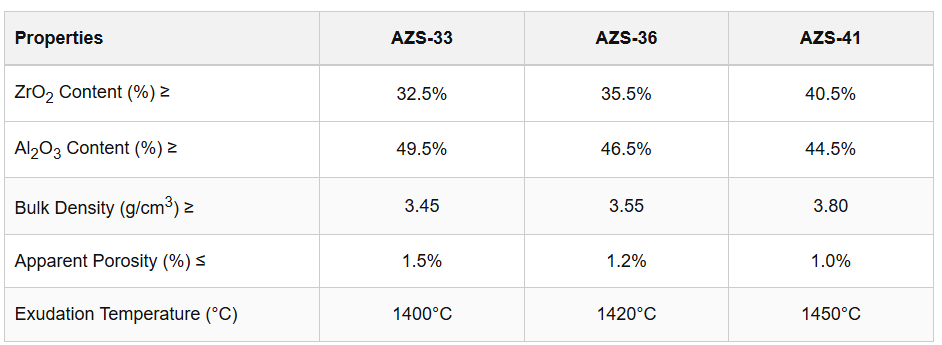
3. Typical Applications in Glass Furnaces
AZS 33#: Used primarily in the superstructure, crown, and regenerator checker settings where direct molten glass contact is minimal.
AZS 36#: The preferred choice for melter side walls and bottom paving, balancing cost and corrosion resistance.
AZS 41#: Engineered for extreme-wear zones such as the glass furnace throat, doghouse corners, and dam blocks where molten glass velocity and alkali concentration are highest.
Sourcing B2B Bulk AZS Bricks?
Highland Refractory provides ISO-certified AZS bricks with precise ±1mm dimensional tolerance. Standard MOQ: 1 Pallet. Full container load (FCL) export services available.
GET A FACTORY QUOTE
Frequently Asked Questions — AZS Refractory Brick
What does AZS stand for and what do the numbers 33, 36, and 41 mean?
Is there a difference between fused cast and sintered AZS bricks?
What is the typical service life of an AZS lining in a glass furnace?
How Fused Cast AZS Brick Is Made
The manufacturing process of fused cast AZS refractory bricks is one of the most technologically advanced and tightly controlled processes in the entire refractory industry. Unlike sintered refractories that are produced through pressing and firing, fused cast AZS bricks are made by electrically melting raw materials at temperatures close to 2000°C and solidifying the molten liquid inside high-precision molds. This process creates an extremely dense, corrosion-resistant microstructure that is essential for use inside glass furnaces.
Understanding the production method is critical for engineers and procurement teams because the quality of the fused cast process directly affects corrosion resistance, bubble index, glass phase exudation behavior, and long-term service life.
Fused cast AZS production includes six core processes: raw material preparation, electric arc melting, casting, annealing, cooling, and machining.
Raw Material Preparation: Al₂O₃ + ZrO₂ + SiO₂ Precision Blending
Raw materials determine the fundamental quality of AZS bricks. High-purity alumina, zirconia, and quartz sand are weighed according to strict chemical composition ratios, usually targeting:
ZrO₂: 33%, 36%, or 41%
Al₂O₃: 45–50%
SiO₂: 12–15%
Trace components (Na₂O, K₂O) strictly controlled below 1.3%
Impurities can promote devitrification, increase glass phase exudation, weaken density, and reduce corrosion resistance against molten glass. Therefore, world-class manufacturers use calcined alumina and stabilized zirconia powders with highly consistent particle size distribution. The uniformity of the raw materials ensures stable melting behavior, making the molten pool cleaner and reducing internal defects.
Electric Arc Melting: 2000°C Complete Fusion
The blended materials are melted in an electric arc furnace at temperatures exceeding 2000°C. The intense thermal energy completely fuses the ingredients into a homogenous molten liquid. This step is essential for forming the unique AZS microstructure—consisting of zirconia crystals embedded within a glassy matrix.
During melting:
Zirconia partially dissolves into the molten glass phase.
Alumina and silica form a viscous liquid matrix.
Impurities float to the top and are removed as slag.
Chemical reactions are completed to stabilize the brick structure.
The melting operator must carefully control furnace power, slag removal, and melt homogenization. A perfectly melted pool minimizes crystalline segregation and creates uniformity throughout the final brick.
Casting: Ordinary Casting, Tilt Casting, and Non-Shrink Casting
Once the molten AZS material reaches the required fluidity, it is poured into molds. The casting method determines the internal density, crystalline distribution, and void formation.
Ordinary Casting (PT, RN, RC)
The most common method, suitable for AZS 33 and AZS 36 bricks.
Produces stable density around 3.55–3.70 g/cm³.
Tilt Casting (QX)
The mold is tilted during pouring, allowing gas bubbles to float away from the working face.
Best for areas requiring low bubble content, such as glass contact surfaces.
Non-Shrink Casting (ZWS, WS)
Used for high-end AZS 41 bricks where minimal shrinkage and superior structural stability are required.
Density reaches 3.85–3.95 g/cm³.
Bubble separation ratio is extremely low (≤1.0).
Casting quality directly affects:
Bubble content
Internal stress distribution
Molten glass corrosion resistance
Brick stability at high temperatures
Leading manufacturers use automatic pouring systems with real-time temperature monitoring to ensure uniform casting.
Annealing: The Key to Eliminating Internal Stress
After casting, the bricks are placed in an annealing kiln. The purpose of annealing is to gradually cool the brick from around 1500°C to room temperature, preventing cracking due to thermal stress.
A precise annealing curve is essential:
Slow cooling between 1200°C–800°C allows stress relaxation.
Controlled descent below 800°C prevents micro-cracks.
Final stabilization ensures the brick maintains structural integrity.
Improper annealing causes hidden cracks, warping, reduced corrosion resistance, or early failure in a glass furnace. High-quality bricks undergo annealing for 20–30 hours depending on size.
Cooling and Demolding: Controlling the Internal Microstructure
After annealing, the mold is removed and the brick is allowed to cool completely. At this stage, the microstructure stabilizes into three phases:
Zirconia crystals (interlocking for corrosion resistance)
Corundum (alumina) crystals (providing mechanical strength)
A glassy matrix (improving inseparability and sealing ability)
The balance between these three phases determines:
Wear resistance
Chemical stability
Bubble exudation
Thermal shock durability
Top-tier manufacturers maintain strict cooling controls to avoid internal void formation or zirconia segregation.
Machining and Surface Finishing
Once fully cooled, the bricks are shaped using diamond tooling. This ensures:
Tight dimensional tolerances (±1 mm)
Flat and smooth contact surfaces
Proper chamfering for installation
Dimensional accuracy is vital for tight furnace structures, reducing leakage risks and ensuring consistent contact between adjacent blocks.
Why Manufacturing Quality Matters
A fused cast AZS brick is only as good as its manufacturing process. Every step—from raw material purity to melting stability to annealing precision—influences the brick’s performance inside a glass furnace. High-quality bricks exhibit:
Low porosity (≤1.0–1.2%)
High density (3.70–4.00 g/cm³)
Low bubble separation ratio
High corrosion resistance
Minimal glass phase exudation
Glass manufacturers know that a furnace’s lifespan and production quality depend heavily on these characteristics.
AZS 33 vs AZS 36 vs AZS 41:Comparison, Performance, and Application Guide
Selecting the correct fused cast AZS brick grade is one of the most critical decisions in designing or maintaining a glass furnace. AZS 33, AZS 36, and AZS 41 are the three standard commercial grades, each offering different corrosion resistance, density, bubble behavior, and service life.
Understanding their differences ensures furnace engineers choose the correct grade for the melter, throat, paving, forehearth, and regenerators. This chapter compares chemical composition, performance, corrosion behavior, and real-world furnace applications.
Chemical Composition Differences
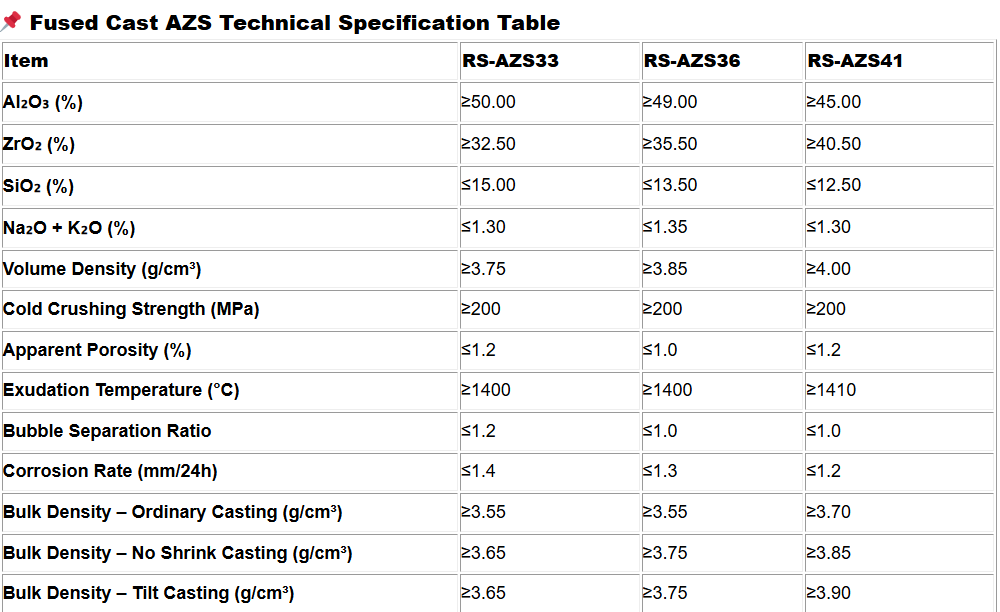
AZS bricks derive their name from the ratio of Al₂O₃ (A), ZrO₂ (Z), and SiO₂ (S). The higher the ZrO₂ content, the better the corrosion resistance against molten glass.
Below is the optimized technical specification table reorganized from your data:
AZS 33# — The Economic and Versatile Grade
AZS 33 is the most widely used grade due to its balanced performance and cost-efficiency. With ~33% ZrO₂, it provides moderate corrosion resistance, making it suitable for working pools, sidewalls, and areas with low–medium wear.
Where AZS 33 Performs Best
Working end & forehearth blocks
Regenerator superstructures
Glass furnaces with lower pulling rates
Soda-lime glass operations
AZS 33 has lower glass exudation compared to AZS 41, making it stable for areas requiring minimal pollution risk.
AZS 36# — The Mid-High Grade with Superior Stability
AZS 36 offers better corrosion resistance than AZS 33 due to its higher ZrO₂ content and higher density. Its bubble index is lower, which is beneficial in glass contact applications.
Where AZS 36 Performs Best
Melter sidewalls
Doghouse
Riser walls
Areas with direct flame radiation
Middle-wear zones in soda-lime and high-alumina glass furnaces
AZS 36 is considered the “workhorse” grade—excellent longevity without the higher cost of AZS 41.
AZS 41# — The Premium Grade for Extreme Corrosion Zones
AZS 41 contains ≥40% ZrO₂, offering the highest corrosion resistance, lowest bubble generation, and the densest microstructure.
It is the preferred material for the most aggressive zones of a glass furnace.
Where AZS 41 Is Required
Furnace throat
Dam blocks
Tank bottom paving
Bubblers and electrodes areas
Melting tank high-erosion hot spots
High-pull float glass operations
Borosilicate and opal glass production
AZS 41 significantly extends furnace life in these harsh zones.
AZS Chemical Properties and Their Impact
The chemical composition of AZS bricks directly determines:
Corrosion resistance
Glass phase exudation behavior
Thermal shock performance
Pollution and bubble formation
Structural stability
Zirconia (ZrO₂)
Improves corrosion resistance
Strengthens the microstructure
Reduces bubble index
Alumina (Al₂O₃)
Increases mechanical strength
Enhances wear resistance
Stabilizes crystalline phases
Silica (SiO₂)
Forms the glassy matrix
Impacts thermal expansion
Alkali Oxides (Na₂O/K₂O)
Low alkali content prevents exudation and devitrification, which is essential for optically clear glass.
Corrosion Resistance of AZS 41: Why It Excels
AZS 41 offers the best corrosion resistance due to:
High ZrO₂ content (≥40.5%)
Dense microstructure (≥4.00 g/cm³)
Low glass phase exudation temperature (≥1410°C)
Ultra-low bubble separation ratio (≤1.0)
Minimal porosity
In molten glass at 1500°C, AZS 41 corroded at ≤1.2 mm/24h—the lowest of any AZS grade.
This is why AZS 41 is indispensable in aggressive environments such as throats, dam blocks, and bubbling zones.
Density and Porosity: The Hidden Performance Indicators
Density and porosity strongly influence service life inside a furnace.
Why Density Matters
Higher density means:
Superior corrosion resistance
Fewer pores for molten glass infiltration
Better structural integrity
Why Porosity Matters
Lower porosity reduces:
Bubble formation
Glass infiltration
Thermal shock cracking
AZS 41 → Highest density, extremely low porosity
AZS 33 → Medium density, economical performance
Thermal Shock Resistance of Fused Cast AZS Bricks
Fused cast AZS is not famous for strong thermal shock resistance because its dense microstructure can crack under rapid temperature changes.
However:
AZS 33 performs the best under thermal shock
AZS 41 performs the worst (but still excellent in corrosion)
This performance is balanced by strategic positioning inside the furnace.
AZS bricks can usually withstand:
3–5 cycles of 1100°C water quenching without structural failure
Thus, AZS is mostly used in constant high-temperature zones with minimal temperature fluctuation.
AZS Refractory Brick Price: What Determines It?
Several factors affect the final price of fused cast AZS bricks:
1. ZrO₂ Content (Most Important Factor)
Higher ZrO₂ = higher cost
AZS 41 > AZS 36 > AZS 33
2. Casting Method
Non-shrink casting (highest price)
Tilt casting
Ordinary casting (lowest price)
3. Brick Shape
Straight shapes cost less; special shapes for throats or sidewalls cost more.
4. Quality Grade
Top-tier factories provide:
Lower bubble index
Better dimensional accuracy
More stable batch quality
5. Global Zircon Sand Market
Zircon prices fluctuate sharply and directly impact AZS brick pricing.
Price Range (for reference, factory-direct)
AZS 33#: $1,200–$1,600 per ton
AZS 36#: $1,500–$2,000 per ton
AZS 41#: $2,000–$2,800 per ton
(Prices vary by region, purity, shape complexity, and shipping.)
When to Use AZS 41 Brick in a Glass Furnace
AZS 41 is the highest-grade fused cast AZS brick, and understanding when it should be used is critical for extending furnace life, reducing corrosion, and ensuring stable, defect-free glass production. Because AZS 41 contains ≥40.5% ZrO₂ and has the highest density and lowest porosity of all AZS grades, it delivers unmatched corrosion resistance and extremely low bubble generation—two properties that are essential for high-pull and high-quality glass furnaces.
AZS 41 is not needed in every part of the furnace; instead, it is selectively installed in the most aggressive zones where molten glass flow, temperature, and chemical attack are at their peak. Using AZS 41 strategically helps balance cost and performance while dramatically extending furnace campaign length.
1. Throat (Furnace Throat Blocks)
The throat is one of the most corrosive areas in a glass furnace because molten glass is constantly pulled through this narrow channel. The combination of:
high flow velocity
high temperature (≈1500°C)
intense chemical attack
erosion and cavitation
makes the throat the single most difficult zone to protect.
AZS 41 is almost universally required here due to its:
highest corrosion resistance
lowest glass infiltration
minimal exudation
low bubble index (prevents seeds/bubbles in final glass)
Furnaces that switch from AZS 36 to AZS 41 in the throat typically extend thermal campaign by 6–12 months.
2. Dam Blocks & Weir Blocks
Dam blocks regulate glass flow and help control glass level. They sit in one of the most aggressive positions, directly in contact with molten glass and circulating currents. AZS 41 ensures:
resistance to molten glass currents
reduced wear on the hot face
low pollution to glass melt
Glass manufacturers producing high-end glass (LCD, borosilicate, pharma glass) nearly always specify AZS 41 for dam blocks.
3. Bubbling / Bubblers Area
Oxygen or air bubbling increases convection to improve melting efficiency. But bubbling also causes severe corrosion because:
localized temperature spikes
glass turbulence
chemical erosion from aggressive foaming
AZS 41 handles bubbling areas far better than AZS 36 or AZS 33 due to:
ultra-dense structure (≥4.00 g/cm³)
lowest corrosion penetration rate (≤1.2 mm/24h)
This dramatically slows down local wear.
4. Melter Sidewalls (Hot Spots)
In high-pull furnaces—especially float glass—sidewall corrosion is one of the main reasons a furnace must be rebuilt. AZS 41 is used specifically in:
burner lanes
high turbulence areas
glass-line hot spots
Using AZS 41 here prevents premature sidewall wear and reduces risk of “doghouse erosion” and “stone defects”.
5. Paving Blocks (Bottom Furnaces for Special Glass)
Most soda-lime furnaces do not use AZS 41 for the bottom, but specialty glass does.
AZS 41 bottom paving is used in:
borosilicate glass
electronic glass
opal glass
high-alkali glass
These melts are much more corrosive than ordinary soda-lime composition.
6. Refiner / Conditioning Zones for High-Clarity Glass
For demanding products—such as ultra-clear glass, lighting glass, pharmaceutical containers—AZS 41 is used in refining areas to prevent:
glass pollution
blistering
stones and knots
beta-cristobalite precipitation
This helps ensure a perfectly homogeneous melt before delivery to the forming process.
7. When You Should Not Use AZS 41
Despite its superior performance, AZS 41 is not always the best choice.
AZS 41 is not recommended in:
crown or superstructure
regenerators
areas with rapid temperature cycling
areas requiring thermal shock resistance
Because AZS 41 is denser, it has slightly lower thermal shock resistance than AZS 33.
Why AZS 41 Is Essential for Modern Glass Furnaces
1. Highest Corrosion Resistance
With ZrO₂ ≥40.5%, AZS 41 resists the most aggressive molten glass compositions. This dramatically slows down furnace wear.
2. Lowest Bubble Index
Bubbles are the biggest enemy of glass quality. AZS 41’s controlled crystal structure minimizes bubble formation.
3. Lowest Exudation
Lower glass-phase exudation prevents:
stones
cords
streak defects
This is especially important in low-iron ultra-clear glass and electronic-grade glass.
5. Longer Furnace Life
AZS 41 can extend furnace life by 20–40%, depending on operating conditions.
Benefits of Fused Cast AZS Brick
Fused cast AZS brick is the most widely used refractory material in modern glass furnaces because it provides a unique combination of corrosion resistance, structural strength, and glass-contact stability that no sintered brick or traditional refractory can match. Unlike fired materials, fused cast AZS bricks are melted at extremely high temperatures (≈1900–2000°C) and then cast into molds, forming a dense, non-porous microstructure with interlocked zirconia and corundum crystals. This manufacturing method is the foundation of nearly all of AZS brick’s performance advantages.
1. Superior Corrosion Resistance in Molten Glass
Molten glass is one of the most corrosive industrial materials on earth. Fused cast AZS brick delivers unparalleled corrosion resistance due to its high ZrO₂ content (33–41%) and extremely low porosity (≤1%). This allows AZS brick to withstand:
high-temperature alkali attack
aggressive silicate corrosion
molten glass erosion
flow turbulence in high-pull furnaces
The higher the ZrO₂ content, the stronger the resistance. AZS 41 resists corrosion at rates as low as ≤1.2 mm/24h, making it indispensable for throat, doghouse, bubbling areas, and glass-contact sidewalls.
2. Low Glass Infiltration and Minimal Exudation
The ultra-dense structure of fused cast AZS brick prevents molten glass penetration and minimizes exudation of the glassy phase. This is crucial for glass quality because exudation can cause:
stones
cords
blisters
glass defects that lead to production waste
AZS bricks are designed to maintain their structure even under long-term chemical attack, ensuring stable glass melt conditions and consistent product quality.
3. Exceptional Resistance to Thermal Load
Glass furnaces operate continuously at 1400–1600°C for up to 10–15 years. Fused cast AZS brick withstands:
high temperatures without deformation
large thermal gradients
sustained thermal pressure
long-term mechanical load
The high alumina content provides structural integrity, while the zirconia crystals reinforce the brick against expansion and cracking.
4. High Mechanical Strength and Structural Stability
AZS bricks have a cold crushing strength of ≥200 MPa, far exceeding traditional sintered refractories. This ensures they can endure:
heavy structural loads from the furnace
molten glass hydrostatic pressure
mechanical wear at the glass line
hardware and equipment stress
This structural stability helps extend furnace life and prevent unexpected downtime.
5. Excellent Glass-Melt Compatibility
Fused cast AZS brick is specifically engineered to avoid polluting the glass melt. The brick’s structure and chemistry minimize:
blistering
secondary melt reactions
corrosion byproducts
stone formation
This is essential in high-end glass production, including float glass, LCD glass, pharmaceutical containers, lighting glass, and solar glass.
6. Long Furnace Campaign and Reduced Maintenance Costs
AZS brick contributes directly to furnace ROI. Because it withstands corrosion longer than any comparable refractory, it:
extends campaign length
reduces sidewall erosion
minimizes unplanned maintenance
allows higher pull rates over time
Upgrading critical areas from AZS 33/36 to AZS 41 typically extends furnace life by 0.5–2 years, yielding major cost savings.
7. Versatility for Different Furnace Zones
Fused cast AZS brick comes in multiple performance grades—AZS 33, AZS 36, and AZS 41—each designed for specific load, temperature, and corrosion conditions:
AZS 33 for crown blocks, working tanks, and non-critical zones
AZS 36 for melting tanks, sidewalls, doghouse, and paving
AZS 41 for throat, bubbling areas, dam blocks, and extreme corrosion zones
This versatility ensures cost-effective furnace design without compromising performance.
Why AZS Brick Is Used in the Glass Industry
AZS refractory brick has become the global standard material for glass furnace construction because it solves nearly all of the high-temperature, high-corrosion challenges unique to glass production. From float glass to container glass, fiberglass, borosilicate glass, opal glass, and solar photovoltaic glass, AZS brick plays an irreplaceable role in extending furnace life, stabilizing glass chemistry, and guaranteeing product quality. Its unique physical and chemical properties make it the most reliable refractory for glass-contact applications.
1. Designed Specifically for Molten Glass Corrosion
Glass melt is a highly aggressive mixture of silica, soda, lime, alumina, and other chemical additives. At temperatures above 1400°C, this melt continuously attacks refractory surfaces. Fused cast AZS brick is produced by melting raw materials at ~2000°C, resulting in a non-porous, highly dense structure that resists chemical dissolution far better than sintered alumina or silica bricks.
The interlocking zirconia crystals inside the AZS matrix function like “anchors,” preventing molten glass from penetrating the structure. This is critical because any penetration results in:
accelerated refractory erosion
structural weakening
contamination of the melt
furnace instability and decreased lifetime
This chemical resistance is the primary reason AZS brick is installed in all glass-contact zones.
2. Ability to Maintain Glass Quality (No Stones, No Cords, No Bubbles)
Glass quality control is one of the biggest concerns in the glass industry. Even microscopic defects can ruin high-end products like LCD glass or pharmaceutical packaging. AZS brick is engineered to maintain glass purity by minimizing:
glassy phase exudation (avoids blisters and cords)
refractory dissolution (reduces stones and seeds)
reaction between molten glass and refractory components
Among all refractory materials used in furnaces, fused cast AZS offers the best balance of corrosion resistance and glass melt compatibility, making it suitable for long-term contact with molten glass.
3. Excellent Performance in Continuous 24/7 Furnace Operation
Glass furnaces run continuously for 8–15 years without shutdowns. This imposes enormous stress on refractory materials. AZS brick provides:
high thermal stability at 1500–1600°C
minimal expansion and deformation
reliable behavior under mechanical load
consistent performance across the entire furnace campaign
These factors make AZS the most dependable refractory for the long-term operation of float tanks, sidewalls, feeder channels, doghouse areas, and working ends.
4. High Resistance to Flame Attack and Alkali Vapors
Besides molten glass, the upper structure of a furnace is exposed to alkali vapors, sulfates, chlorides, and aggressive flame chemistry. Although the crown typically uses fused silica or sintered silica bricks, AZS is still used in areas where alkali condensation is severe. AZS has a high tolerance for alkali vapor reactions, protecting against premature damage and extending furnace lifetime.
5. Suitable for Both Fuel-Fired and Electric-Boosted Furnaces
Modern glass furnaces increasingly use electric boosting to increase pull rates and improve energy efficiency. Electric boosting introduces intense localized heat and rapid temperature gradients. AZS brick is preferred in these environments because its dense microstructure resists:
rapid heating cycles
intense local hot spots
electrical arcing (when using specific grades)
This adaptability to both traditional and advanced furnace designs reinforces its importance in the industry.
6. Proven Lifespan and Cost Efficiency
The glass furnace is one of the most expensive industrial assets, and refractory failure directly determines its operational lifespan. Furnace reconstruction costs millions of dollars, making long-life refractories essential.
AZS brick delivers the lowest overall cost per ton of glass produced because it:
prolongs furnace service life
reduces downtime
decreases maintenance requirements
supports higher-quality production
allows higher pull rates
A well-designed AZS configuration can extend furnace life by 1–3 years, resulting in enormous cost savings.
AZS 33 vs AZS 36 vs AZS 41: Which Grade Should You Choose?
Choosing between AZS 33, AZS 36, and AZS 41 is one of the most important decisions for any glass furnace operator. Each grade has a distinct chemical composition, level of zirconia content, corrosion resistance, and application suitability. Understanding these differences helps furnace designers and procurement teams select the most cost-effective and performance-optimized refractory configuration.
1. Understanding the Grade System
AZS refers to Alumina–Zirconia–Silica fused cast bricks.
The numbers 33, 36, and 41 represent the minimum ZrO₂ content:
AZS 33 → ~33% ZrO₂
AZS 36 → ~36% ZrO₂
AZS 41 → ~41% ZrO₂
Higher zirconia content generally means higher corrosion resistance, lower glass-phase exudation, and better stability in glass-contact zones.
2. Full Comparison Table
Below is a clear comparison of the three main AZS grades used in glass furnaces:
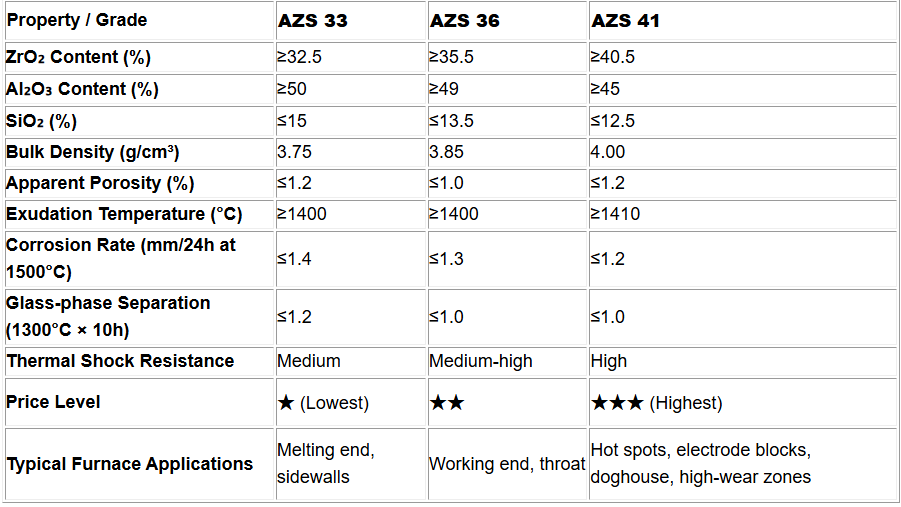
Typical Furnace Applications Melting end, sidewalls Working end, throat Hot spots, electrode blocks, doghouse, high-wear zones
3. When to Use Each AZS Grade
AZS 33 — Economical, widely used, suitable for general zones
AZS 33 is the most cost-effective grade and is commonly installed in lower-wear areas such as:
melter sidewalls (non-hot spots)
bottom paving blocks
doghouse areas with moderate corrosion
working end and forehearth walls
It provides excellent value where corrosion rates are moderate.
AZS 36 — Balanced performance and cost
AZS 36 offers a solid balance between corrosion resistance and price. It is widely used in:
feeder channels
throat areas
burner blocks
working end walls
It performs better than AZS 33 in slightly more aggressive environments.
AZS 41 — Maximum corrosion resistance and lowest glass pollution
AZS 41 is the premium grade with the highest zirconia content. It is designed for the toughest glass-contact and high-wear positions:
melter hot spots
fused cast bonded corners
throat blocks
electrode corner blocks
high-pull rate float glass furnaces
Its superior corrosion resistance makes it indispensable in premium glass manufacturing (e.g., LCD, borosilicate, solar glass).
4. How to Choose Between the Grades
Selecting the right AZS grade depends on:
glass type (soda-lime, borosilicate, opal, E-glass)
pull rate and furnace productivity level
temperature zones and expected wear rates
design life (typical 8–15 years)
budget and maintenance strategy
General selection rule:
AZS 33 → Standard corrosion zones
AZS 36 → Medium corrosion, improved quality
AZS 41 → Severe corrosion, glass-contact hot spots
For plants producing solar glass, display glass, pharmaceutical glass, or operating high-pull, long-campaign furnaces, AZS 41 is almost always recommended.
Chemical Properties of AZS Brick: Why Composition Determines Performance
The exceptional performance of fused cast AZS bricks is fundamentally determined by their chemical composition. AZS refractory bricks are made from a precise mixture of alumina (Al₂O₃), zirconia (ZrO₂), and silica (SiO₂), melted in an electric arc furnace at temperatures above 1900°C and cast into molds. Once solidified, the complex chemistry of these phases defines the brick’s resistance to glass corrosion, thermal shock stability, and mechanical strength.
1. Core Chemical Components of AZS Bricks
Zirconia (ZrO₂) — The key to anti-corrosion performance
Zirconia is the most important element in fused cast AZS brick. Its chemical stability and hardness are critical for resisting both molten glass erosion and alkali vapor corrosion.
ZrO₂ content: 33% / 36% / 41% (depending on grade)
Higher ZrO₂ → higher corrosion resistance
Higher ZrO₂ → lower glass-phase exudation
Higher ZrO₂ → better resistance to bubble formation
Zirconia forms interlocking eutectic structures with alumina, creating a ZrO₂–Al₂O₃ eutectic phase that resists dissolution in molten glass.
Alumina (Al₂O₃) — Structural strength & thermal endurance
Alumina contributes:
mechanical strength
resistance to deformation
high refractoriness under load
better thermal shock performance
Al₂O₃ content typically ranges from 45–50%, providing the backbone of the brick’s structural integrity.
Silica (SiO₂) — Controls the glassy phase
SiO₂ exists mostly in the glass phase of AZS brick. Lower SiO₂ content means:
reduced glass-phase exudation
lower contamination of the molten glass
better resistance to phase separation
The best-performing AZS 41 bricks use ultra-low SiO₂ content (≈12%), minimizing defects in high-quality glass production.
Alkali (Na₂O + K₂O) — Controlled to prevent contamination
Alkali oxides are strictly limited because they migrate into glass, causing stones and cords.
AZS standards require:
≤1.3% alkali content for all AZS grades
Controlling these impurities is essential for producing optical-grade, solar, and display glass.
2. Phase Structure of AZS Bricks (Critical for Glass Contact Zones)
Fused cast AZS bricks contain three primary phases:
ZrO₂ dendritic crystals (corrosion-resistant skeleton)
Al₂O₃–ZrO₂ eutectic phase (interlocked strengthening network)
SiO₂-rich glassy phase (fills gaps between crystals)
The balance between crystalline and glassy phases determines:
corrosion resistance
bubble generation tendency
thermal shock behavior
infiltration resistance
AZS 41 contains the highest crystalline fraction, making it the most resistant to molten glass attack.
3. Why Chemical Composition Determines Furnace Performance
Corrosion Behavior
Higher ZrO₂ reduces the dissolution rate in molten glass, allowing AZS 41 to maintain shape even after years of use in hot zones.
Bubble Formation
Impurities in the glass phase can release gases at high temperature.
AZS 41’s cleaner glass phase dramatically reduces bubble-related defects.
Glass Quality Impact
Low SiO₂ and low alkali minimize:
cords
inclusions
stones
crystalline deposits
This is critical for solar panel substrates, LCD glass, and pharmaceutical containers.
4. Chemical Stability Ranking of AZS Grades
Grade Chemical Stability Suitability
AZS 41 ★★★★★ Highest Premium glass, high-pull furnaces
AZS 36 ★★★★☆ High Working end, throat, feeders
AZS 33 ★★★☆☆ Medium Sidewalls, non-hot spots


Send inquiry
Please Leave your message you want to know! We will respond to your inquiry within 24 hours!