
News detail
Boiler Refractory Lining Solutions
1. Why CFB and PC Boiler Refractory Specifications Must Differ
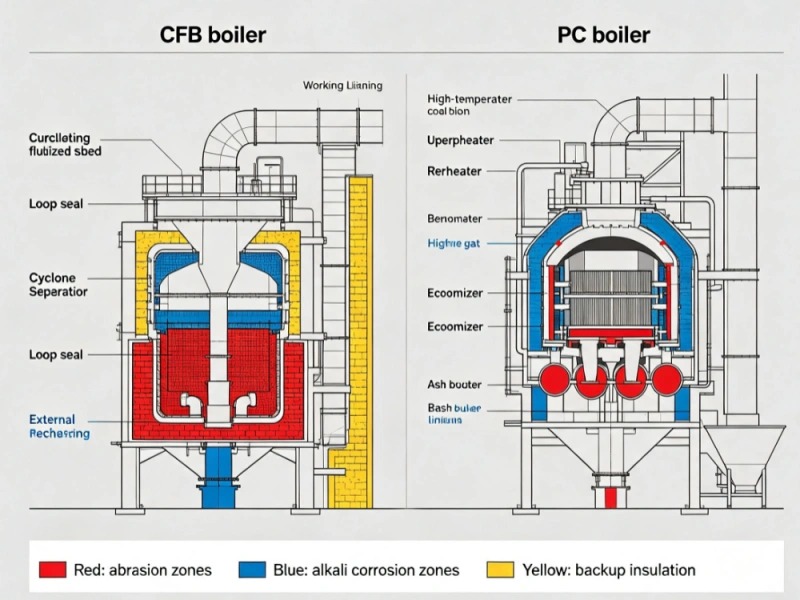
The most expensive mistake in power plant refractory procurement is applying a pulverized coal boiler lining specification to a circulating fluidized bed boiler — or vice versa. While both boiler types burn coal and produce superheated steam, their refractory linings face fundamentally different dominant failure mechanisms.
In a CFB boiler, the furnace chamber operates as a dense fluidized bed of coal, limestone sorbent, and ash particles suspended in an upward-flowing combustion air stream at 850–950°C. The limestone particles — essential for in-furnace SO2 capture — act as a continuous micro-abrasive medium against the refractory lining protecting the water-wall tubes. This is not occasional impact; it is constant, high-velocity scouring at every point of the lower furnace. The refractory specification must prioritize abrasion resistance above all other properties.
In a pulverized coal boiler, finely ground coal is injected as a dust cloud into the furnace and burns in suspension at 1300–1650°C. The dominant refractory threat is alkali sulfate corrosion. Sodium and potassium compounds in the coal ash volatilize in the high-temperature combustion zone, then condense as liquid alkali sulfates on cooler refractory surfaces in the superheater, reheater, and economizer gas passes. These liquid sulfates react with the silica phase in standard alumina-silicate refractories, forming low-melting-point glassy phases that dissolve the brick matrix.
Specifying a single refractory grade for both boiler types is an engineering error that leads to premature lining failure within the first campaign. The correct approach defines each boiler zone by its dominant failure mechanism and matches the refractory composition — aggregate type, binder system, SiC or Cr2O3 addition, porosity target — to that specific mechanism.
2. Zone-by-Zone Refractory Selection — CFB Boilers
A CFB boiler can be divided into five distinct refractory zones, each demanding a different material specification. Applying a uniform grade across all zones wastes material cost in low-stress areas and under-specifies critical wear points.
| Boiler Zone | Operating Conditions | Highland Recommended Material | Technical Reasoning |
|---|---|---|---|
| Lower Furnace (Dense Bed Zone) | 850–950°C, dense fluidized bed scouring | SiC-Reinforced Wear-Resistant Castable (CCS ≥100MPa) | SiC aggregate provides extreme abrasion resistance; high CCS absorbs fluidized particle impact energy without surface fracture |
| Upper Furnace (Dilute Phase) | 800–900°C, moderate particle loading | High-Alumina Wear Castable (Al2O3 ≥75%, CCS ≥80MPa) | Sufficient abrasion resistance for lean-phase particle density; more cost-effective than full SiC grade |
| Cyclone Separator | 800–900°C, high-velocity tangential flow, maximum scouring | SiC-Reinforced Castable + Steel Fiber (CCS ≥120MPa) | Tangential particle acceleration multiplies impact energy; maximum abrasion-resistance grade mandatory |
| Loop Seal & Return Leg | 800–900°C, dense particle flow, erosion | High-Alumina Wear-Resistant Castable (CCS ≥80MPa) | Dense particle sliding abrasion; high CCS resists gradual material loss over campaign life |
| Backup Insulation Course | Ambient–600°C at cold face | K26 IFB + Ceramic Fiber Blanket | Multi-layer insulation reduces outer casing temperature to <90°C; K26 selected for thermal stability margin |
3. Zone-by-Zone Refractory Selection — Pulverized Coal Boilers
Pulverized coal boiler refractory linings are governed by a thermal gradient: the hottest zones demand high refractoriness with alkali resistance, while cooler downstream zones prioritize acid gas condensation resistance.
| Boiler Zone | Operating Conditions | Highland Recommended Material | Technical Reasoning |
|---|---|---|---|
| Furnace Chamber (Burner Zone) | 1300–1650°C, radiant heat, slag | High-Alumina Fire Brick (Al2O3 ≥75%, CCS ≥60MPa) | Sintered corundum-mullite matrix resists ash slag wetting and penetration at peak furnace temperature |
| Superheater / Reheater | 800–1100°C, alkali sulfate condensation | Chrome-Corundum or SiC Gunning Mix | Cr2O3 or SiC phase is chemically inert to liquid Na/K sulfate attack; prevents tube wastage behind refractory |
| Economizer & Air Preheater | 300–600°C, fly ash loading, acid dew point risk | Fireclay Brick or Medium Alumina Brick (Al2O3 45–55%) | Adequate refractoriness for moderate temperatures at lower material cost; dense brick resists fly ash erosion |
| Flue Gas Ducting | 150–400°C, acid condensate risk | Acid-Resistant Brick or High-Alumina Castable | H2SO4 condensation below acid dew point; acid-resistant grade prevents lining deterioration in low-load operation |
| Backup Insulation Course | Ambient–400°C at cold face | K23 IFB + Ceramic Fiber Blanket | Economy insulation grade for moderate cold-face temperatures; K23 offers lowest thermal mass for cycling efficiency |
4. The Abrasion Problem — Fluidized Bed Scouring and SiC Reinforcement
The CFB boiler furnace chamber presents an abrasion environment unlike any other in thermal engineering. A dense bed of limestone sorbent particles — typically 0.5–2.0mm in diameter, with a bulk density of approximately 1400 kg/m³ — is fluidized by combustion air at superficial velocities of 4–7 m/s. Every particle collision with the water-wall tube protective refractory transfers kinetic energy that erodes the lining surface. This is not a chemical process; it is a purely mechanical wear mechanism operating continuously for 8,000+ hours per year.
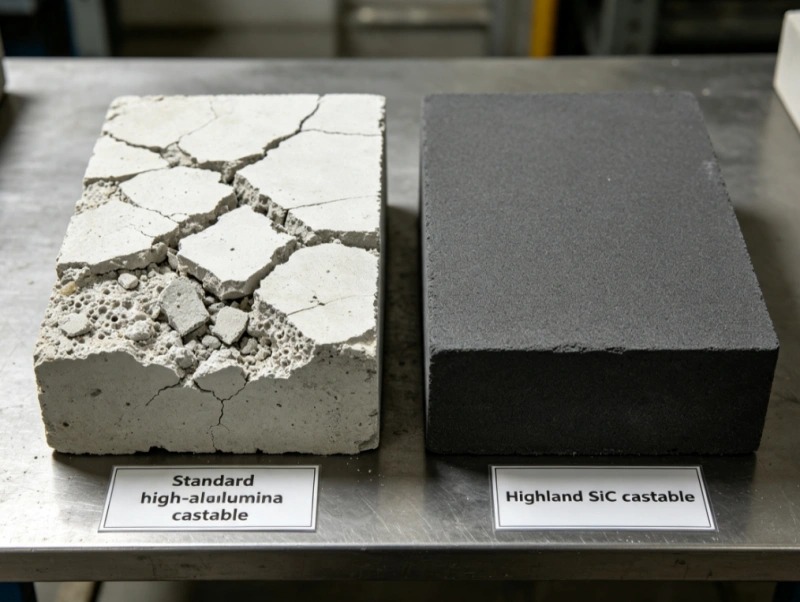
Standard high alumina castable, which performs adequately in the upper furnace lean-phase zone, loses material thickness at a rate of 3–5mm per 1,000 hours in the dense bed zone. At this rate, a 50mm lining requires patch repair after 10,000–16,000 hours — roughly 15–24 months. For a baseload power plant, this maintenance frequency is unacceptable.
Highland’s CFB-grade SiC-reinforced wear-resistant castable solves this by substituting a portion of the high-alumina aggregate with silicon carbide particles (SiC content 8–15%). Silicon carbide has a Mohs hardness of 9.5 — second only to diamond — and its angular particle morphology interlocks under compaction to form a surface that resists particle impact erosion 3–5 times longer than standard high-alumina castable. Measured per ASTM C704 (abrasion resistance test), our SiC castable achieves a volume loss of ≤5 cm³ compared to ≥14 cm³ for standard high-alumina grades. For the cyclone separator — where tangential gas acceleration multiplies particle impact velocity — we add 2.5–3.5 wt% steel fiber reinforcement, pushing CCS above 120MPa to resist the mechanical fatigue from repeated high-energy impacts.
5. Thermal Shock and Alkali Spalling During Boiler Startup
Power plant boilers are not steady-state machines. A baseload coal-fired unit may start from cold 3–5 times per year; a load-following unit or a biomass boiler on an intermittent feedstock schedule may cycle 15–30 times annually. Each cold start represents a full thermal cycle for the refractory lining: the furnace chamber transitions from ambient to 850°C (CFB) or 1300°C (PC) within 4–8 hours during controlled ramp-up, and potentially much faster during an emergency restart.
Thermal shock damage manifests as surface spalling — the hot face of the refractory brick or castable expands faster than the cooler interior, creating tensile stress at the interface that exceeds the material’s modulus of rupture. In CFB boilers, this is compounded by alkali spalling: during startup, residual alkali sulfates deposited on the refractory surface during the previous campaign absorb moisture from the ambient air and form hydrated alkali phases that expand volumetrically by up to 30%, physically wedging the refractory surface apart before the boiler even reaches operating temperature.
Highland’s boiler refractory specification addresses both mechanisms. For CFB boiler dense bed zones, we specify a SiC castable with controlled porosity gradient — higher porosity at the cold face for thermal expansion compliance, denser at the hot face for abrasion resistance. For PC boiler superheater zones, we specify phosphate-bonded high-alumina plastic refractory rather than cement-bonded castable — the phosphate bond has superior resistance to alkali sulfate chemical attack and does not undergo the “strength valley” that cement-bonded castables experience between 600–900°C, which is precisely the temperature range where alkali spalling is most severe.
6. Technical Specification — Boiler Refractory Grades
| Parameter | SiC Wear Castable (CFB Bed) | High-Alumina Castable (CFB Upper Furnace) | High Alumina Brick (PC Furnace) | IFB K26 (Backup) |
|---|---|---|---|---|
| Al2O3 (%) | ≥ 60% | ≥ 75% | ≥ 75% | 42–46% |
| SiC Content (%) | 8–15% | — | — | — |
| CCS after 1100°C (MPa) | ≥ 100 | ≥ 80 | ≥ 60 | ≥ 2.0 |
| ASTM C704 Abrasion (cm³) | ≤ 5 | ≤ 9 | ≤ 12 | — |
| Max Service Temp (°C) | 1450°C | 1550°C | 1650°C | 1400°C |
| Apparent Porosity (%) | ≤ 18% | ≤ 20% | ≤ 22% | 60–70% |
7. FAQ — Boiler Refractory Lining
Q1: Our CFB boiler lining fails at the fuel feed inlet — quality issue or wrong specification?
Almost always a specification issue. The feed inlet is the CFB’s most abrasive point: coal and limestone particles impact at 5–7 m/s, eroding standard high-alumina castable (CCS 60–80MPa) within 6–12 months. The correct specification is SiC-reinforced wear-resistant castable with CCS ≥100MPa at ≥60mm thickness. Do not over-specify the entire furnace — upgrade only the impact zone.
Q2: What refractory for a biomass boiler burning high-moisture wood chips?
SiC castable (CCS ≥80MPa) for the grate and lower combustion chamber — resists both mechanical fuel impact and potassium-rich slag (K2O up to 15% in wood ash). Phosphate-bonded high-alumina refractory for the superheater zone — more resistant to potassium sulfate condensation than cement-bonded grades. K26 IFB for backup insulation.
Q3: What is the curing and bake-out procedure for CFB boiler castable?
24h ambient cure after installation. Controlled bake-out: ramp ≤20°C/h to 150°C, hold 4h; ramp ≤30°C/h to 600°C, hold 4h; then ramp to operating temperature at ≤50°C/h. Total: ~36–48 hours. Never rush to operating temperature in under 8 hours — trapped moisture converts to high-pressure steam and causes explosive spalling. Highland provides a detailed baking curve with every supply contract.
Q4: Do you supply refractory anchors and steel fibers with the castable?
Yes. 310S stainless steel V/Y-anchors (6–8mm diameter) with ceramic ferrules, plus melt-extracted 310 stainless steel fibers (0.5×25mm, aspect ratio ~50) at 2.5–3.5 wt%. All pre-fabricated to your boiler drawings, shipped in the same container as the refractory — one supplier, one shipment.
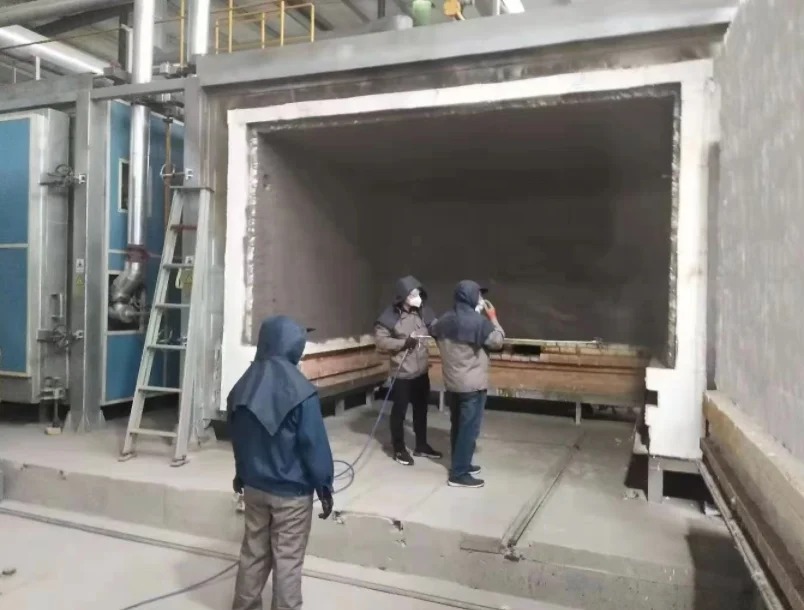
Q5: How long does a full CFB furnace chamber relining shutdown last? 30–45 days for full demolition, anchor replacement, refractory installation, curing and bake-out — depending on furnace dimensions. Targeted repairs (feed inlet or cyclone patch): 15–25 days. Pre-stage materials and anchors on-site before boiler shutdown to minimize outage duration. Emergency stock of high-frequency CFB grades available for mid-campaign repairs.


Send inquiry
Please Leave your message you want to know! We will respond to your inquiry within 24 hours!