
News detail
Lime Kiln Refractory EPC
Hongtai’s EPC Core Services in Lime Kiln Refractory
Engineering Services
- Detailed Survey and Diagnosis: Evaluation of existing lime kilns/new kilns, process parameter analysis.
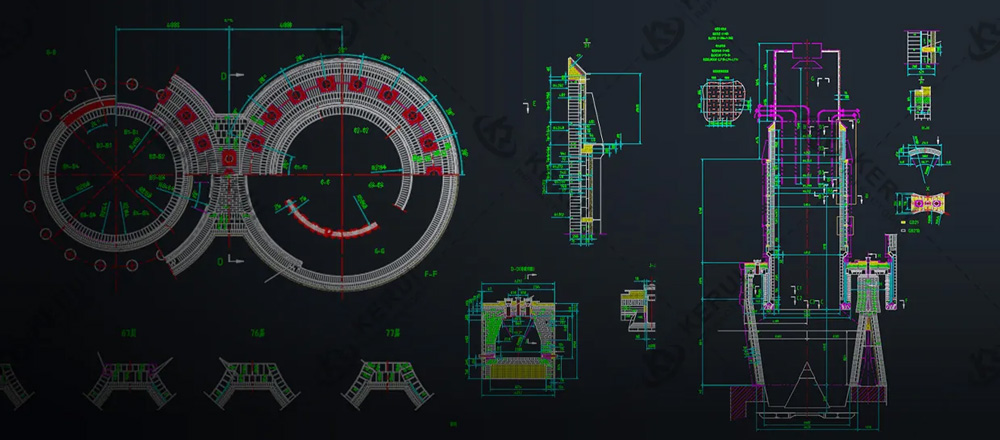
- Customized Engineering: Lime kiln linings structure engineering, refractory material selection and configuration plan (different materials for different regions), thermal simulation calculation.
- Drawings and Technical Specifications: Provide detailed construction drawings and refractory material technical parameter requirements.
Procurement Services
- High-quality Resources: In addition to our own high-quality refractory products, Hongtai Kiln Refractory has established strategic cooperation with well-known equipment suppliers.
- Strict Quality Control: Incoming material inspection, performance testing (laboratory records can be provided).
- Logistics management: Ensure that refactory materials arrive on time and safely.
Construction Services
- Professional Construction Team Guidance: Guidance from skilled workers with rich experience in lime kiln masonry.
- Standardized Construction Process: Demonstrate key construction process guidance (such as masonry, anchoring, castable construction, expansion joint treatment).
- Quality Management System: Construction process monitoring, quality inspection and acceptance standards.
Value-added Services
- Operation and Maintenance Consultation: Best practice recommendations for start-up, shutdown, and thermal cycling procedures.
- Refractory Life Assessment and Prediction: Predictive maintenance planning based on kiln operating history and material behavior.
- Local Maintenance and Emergency Repair Services: 24/7 emergency support for unplanned shutdowns or refractory failure.
Lime Kiln Refractory Linings
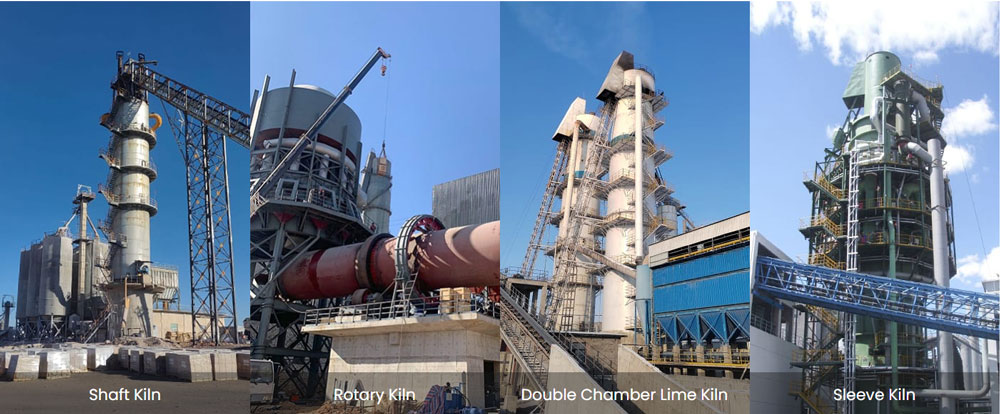
Lime kiln is used to calcine limestone at high temperature to produce quicklime. As a key thermal equipment for metallurgy, environmental desulfurization, chemical synthesis and cement production, its operating efficiency directly determines the quality of end products and energy consumption costs. EPC service of Hongtai Kiln Refractory Refractory covers all scenarios of kiln types.
Part.1 Shaft Lime Kiln Refractories
Shaft kiln is mainly used to produce ordinary lime. It adopts a vertical cylindrical single-chamber design with a simple structure and low investment.
- Capacity: Small and medium scale (usually ≤300 tons/day);
- Refractory Focus: Withstand vertical mechanical loads and material wear.
| Location | Temp. Range | Characteristics | Suitable Refractories |
|---|---|---|---|
| Kiln Throat | 120–300°C | Impact resistance; | Steel fiber-reinforced refractory castable; |
| Preheating Zone | 300–800°C | Thermal shock resistance; Chemical erosion resistance (CO₂, sulfides); |
Fireclay brick; 55% alumina brick; Lightweight insulating brick; |
| Burning Zone | 1000–1300°C | High-temperature strength; Alkali erosion resistance; Abrasion resistance; |
Magnesia brick or magnesia chrome brick; Dolomite brick; 75% alumina brick; SiC brick; |
| Burner Perimeter | 1050–1550°C | Flame erosion resistance; | Corundum brick or chrome corundum brick; |
| Kiln Lining Insulation | 200–1000°C | Heat loss reduction; Shell protection; |
Calcium silicate board; Ceramic fiber blanket; Lightweight refractory castable; |
| Cooling Zone | 800–200°C | Thermal shock resistance; Mechanical wear resistance (lime falling impact); |
High-strength alumina brick; Phosphate-bonded brick; Abrasion-resistant castable; |
| Discharge Outlet | 60–150°C | Thermal shock; Mechanical wear; Alkali erosion; Sudden temperature changes. |
Abrasion-resistant castable or SiC brick. |
Part.2 Rotary Lime Kiln Refractory
Rotary kiln is widely used in cement, refractory raw materials and metallurgical industries. The core is an inclined steel cylinder, which causes the material to tumble and calcine through slow rotation.
- Capacity: 300-1200 tons/day;
- Refractory Characteristics: It needs to adapt to dynamic thermal stress. And different calcined materials (limestone/dolomite, and others) use differentiated refractory solutions.
| Location | Temp. Range | Characteristics | Suitable Refractories |
|---|---|---|---|
| Preheating Zone | 800–1000°C | Moderate temperatures requiring thermal cycling resistance; Resist CO₂/sulfide gas attack; Thermal shock stability for frequent kiln starts/stops; |
55-75% high alumina brick; Fireclay brick; |
| Transition Zone | 1000–1300°C | Steep thermal gradients demanding thermal shock stability; Chemical transition with partial CaO/sulfide attack; |
Phosphate-bonded high alumina brick; 30-50% SiC composite brick; |
| Burning Zone | 1300–1450°C | Sustained ~1400°C exposure; Alkali resistance against CaO/K₂O/Na₂O; Thermal shock stability to prevent spalling; |
50-70% MgO magnesia alumina spinel brick; Dolomite brick (≥90% MgO+CaO); |
| Cooling Zone | <800°C | Mechanical wear from falling lime particles; Thermal shock from cooling air; |
≥75% alumina abrasion-resistant castable; |
| Kiln Head/Discharge | 1000–1200°C (Head); 200–400°C (Discharge); |
Extreme abrasion from lime product & particles; High-temperature oxidation at kiln head; |
≥85% Al₂O₃ corundum-mullite brick; ≥60% SiC castable. |
Part.3 Twin Shaft Lime Kiln Refractory
Twin shaft kiln is an energy-efficient dual-shaft structure. The two kiln chambers alternately calcine and preheat to achieve waste heat recovery.
- Capacity: 400-800 tons/day;
- Refractory Core Requirements: Extreme temperature alternation requires materials to have ultra-high thermal shock stability (>30 rapid cooling and heating cycles).
| Location | Temp. Range | Characteristics | Suitable Refractories |
|---|---|---|---|
| Preheating Zone | 800–1000°C | Thermal shock resistance (violent temp. swings from reversing cycles); Resist CO₂/sulfide attack; Moderate refractoriness & long-term stability; |
55-65% high alumina brick; Low-cement high alumina castable (irregular areas); |
| Burning Zone | 1200–1400°C | Extreme temperature resistance (≥1400°C); Alkali resistance (CaO, K₂O, Na₂O); High thermal shock stability (reversing combustion); |
Magnesia alumina spinel brick (MgAl₂O₄, 50-70% MgO); ≥90% MgO+CaO dolomite brick; |
| Cooling Zone | <800°C | Abrasion resistance (lime particle impact); Thermal shock resistance (cooling air); High compressive strength (material load); |
≥75% Al₂O₃ abrasion-resistant castable; Phosphate-bonded high alumina brick; |
| Insulation Layer | 800-1200°C | Low thermal conductivity (energy efficiency); Lightweight (reduced kiln load); |
Nano-microporous insulation boards; Ceramic fiber modules; |
| Crossover Channel | 1100-1250°C | Exceptional thermal shock resistance (1000°C – 1400°C swings); Gas erosion resistance (high-velocity dust-laden flow); Chemical corrosion resistance (S, CO gases); |
≥70% SiC silicon carbide brick; ≥85% Al₂O₃ corundum-mullite brick. |
Part.4 Annular Shaft Kiln Refractories
Sleeve kiln adopts a unique double-tube design (inner tube + outer tube), which allows hot gas and limestone to flow in the same direction through the principle of parallel calcination, with uniform heat distribution and high activity.
- Capacity: 500-1000 tons/day;
- Refractory Challenges: The inner tube is subjected to high temperature corrosion + mechanical stress, and the magnesia alumina spinel bricks need to be resistant to CO erosion.
| Location | Temp. Range | Characteristics | Suitable Refractories |
|---|---|---|---|
| Preheating Zone (Outer Shell) |
800–1000°C | Moderate thermal stress; Material abrasion at high-flow areas; Cyclic temperature variations; |
55-65% high alumina brick; ≥70% SiC brick (material impact areas); |
| Burning Zone (Inner Cylinder) |
1200–1400°C | Peak temperature exposure; Severe CaO alkali attack; Thermal cycling from kiln operations; Steep radial thermal gradients; |
Magnesia alumina spinel brick (MgAl₂O₄, 50-70% MgO); |
| Burner Perimeter | 1200-1600°C | Direct flame impingement; High-velocity particle erosion; Sulfur attack (petroleum coke fuels); Thermal spalling risk; |
99% Al₂O₃ corundum brick; Chrome-corundum brick (Cr₂O₃ 5-15%); |
| Cooling Zone (Bottom Section) |
≤800°C | Mechanical wear from falling lime; Thermal shock during quenching; Structural loading; Joint integrity challenges; |
≥75% Al₂O₃ castable (seam-free construction); Phosphate-bonded high alumina brick. |


Send inquiry
Please Leave your message you want to know! We will respond to your inquiry within 24 hours!